
The platform automatically identifies and highlights similar ideas/content during submission, helping avoid duplication and fostering collaboration on aligned concepts.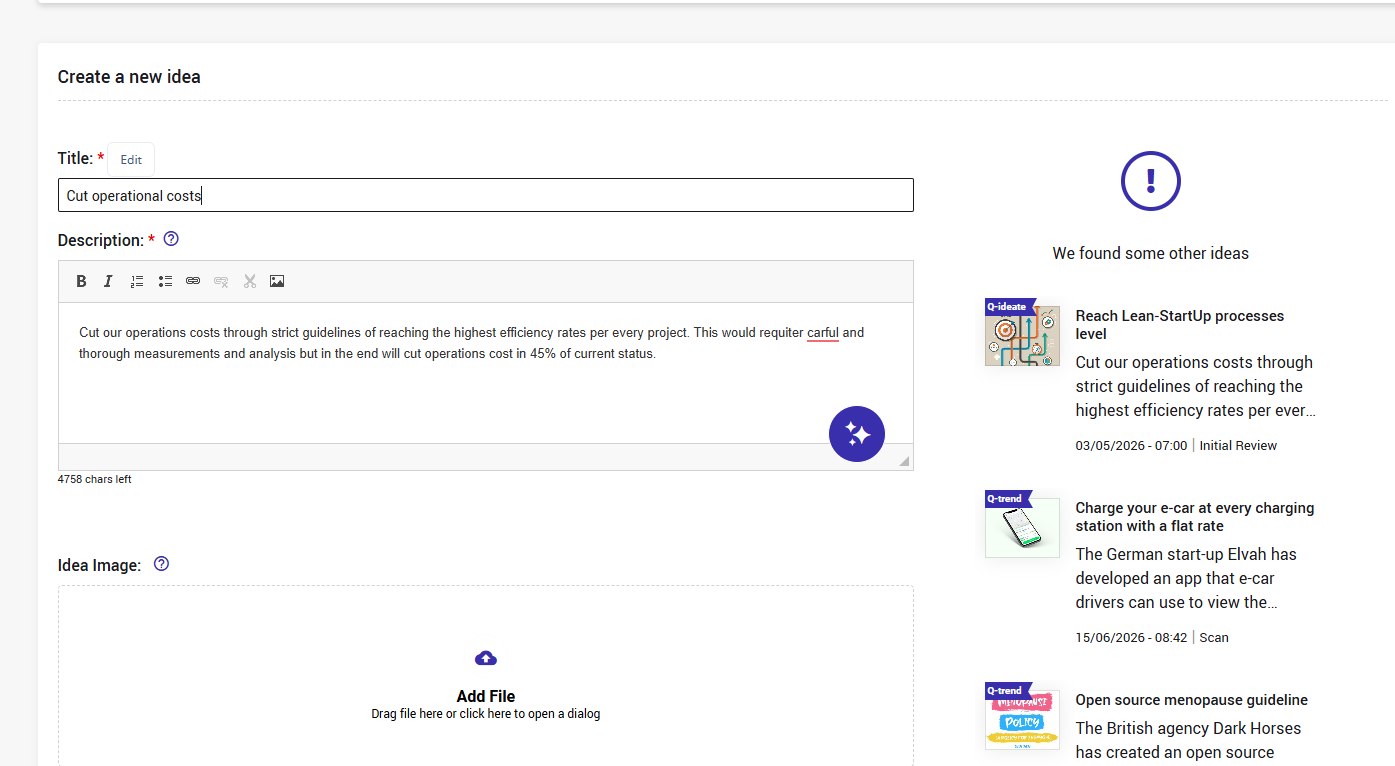
In addition, at any given state in the workflow, the system dynamically matches and recommends related ideas or experts based on the accumulated information, ensuring relevant connections are made as the idea evolves.
Qmarkets is using contextual search across all text field, including comments.Contextual search is a more advanced search technology that focuses on the context of the query as well as the intent of the user in order to fetch the most relevant set of results. Consequently, when searching for a specific keyword, our search engine will not only look for the exact occurrences but rather present in the resulting search all related words (synonyms), across all languages.
The results respect user roles and permissions, ensuring users see only relevant content.
What the diff between this search and searching with AI?
The above “similar ideas” capability is based on the SOLR search engine and works as a relevance-based search, not as generative AI. When an idea is submitted or updated, key text fields such as the title, description, tags, and categories are indexed by SOLR. The system then breaks the text into searchable terms, applies standard search techniques such as stemming, stop-word removal, fuzzy matching, and field weighting, and compares the new idea against existing ideas in the same environment. SOLR ranks potential matches based on textual similarity and relevance scoring, so ideas with overlapping keywords, related wording, or similar phrasing are surfaced as possible duplicates or related ideas. This approach is fast, deterministic, and well-suited for keyword-based similarity, but it does not “understand” meaning or context in the same way that our modern Iris module does - using true AI-based semantic matching with in-depth analysis of context and meaning.