
Interconnectivity allows you to connect entities such as ideas, campaigns, and projects between different subsystems. The initial set up of the Interconnectivity feature should be completed by your CSM before it can be used.
There are 3 main decisions you need to take:
- In which states along the workflow, it should be possible to create new connections
- What information from an interconnected entity should be disabled and where, and which users have permissions to view the interconnectivity section
- Whether and what info on new created entity should be auto-pupolated based on the info that already exists in the entity it is connected to
Activating the Feature
Select the "features" option within the workflow state.

From the Interconnectivity section, select the toggles for each option. The options displayed will be based on the set up by your CSM.

Setting the Display Options
Further display options can be configured within the Features Settings tab.

In the Interconnectivity section, there is the option to change the visibility of the feature, and what data is displayed.

"Create and manage interconnectivity visibility" manages who can see the feature.

"Create and manage interconnectivity" allows you to select which data is visible per each connection.

Extra fields to display on the Trend page - you can select extra data fields to display under the connected idea.

Extra columns to include on the Trends page - you can select extra data columns that will appear within the All Data report.

Extra Filters to Include on the Trends page and KPI reports - you can add filter fields for the All Data report.

Mapping fields between the connected entities
You can determine what info on new created entity should be auto-pupolated based on the info that already exists in the entity it is connected to.
This is done via a simple mapping between the fields per connection on the SS of the entity that is created.
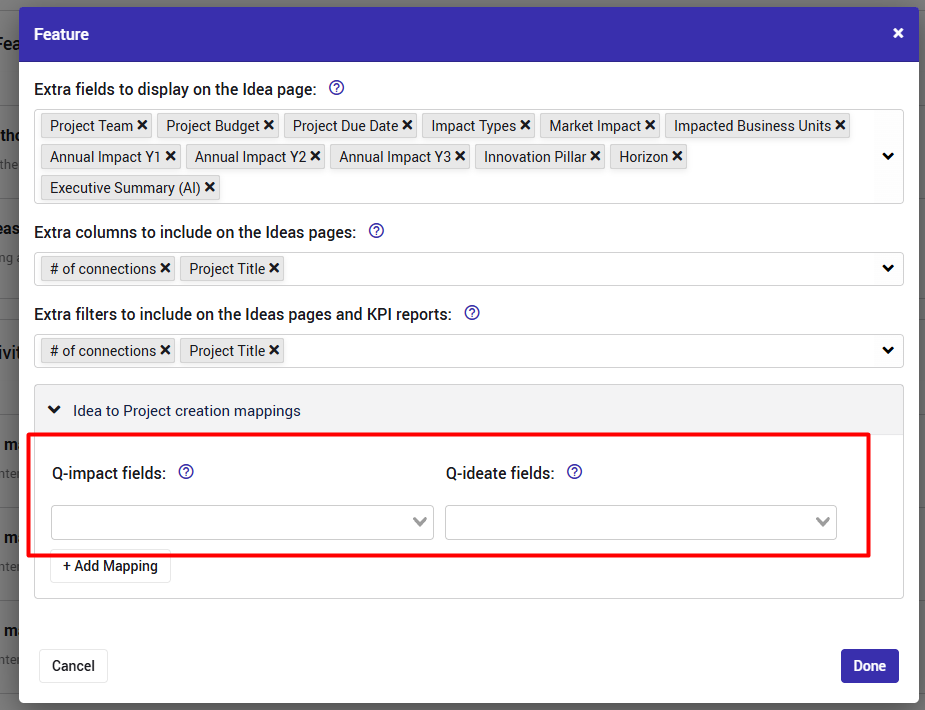
Note re select fields:
Since only the fields are mapped, the values of the fields that are mapped (e.g. High, Med, Low) should exists in both sides.
No new options will be generated as part of the process.
If an option with a similar name does not exists, the new submission form will not include the origin value.
In case the list of values is long there is a way to export it from one subsystem, and then export on the other subsystem.
For more information on how to use Interconnectivity, please visit: